Andertons Music Co.
Service
Product
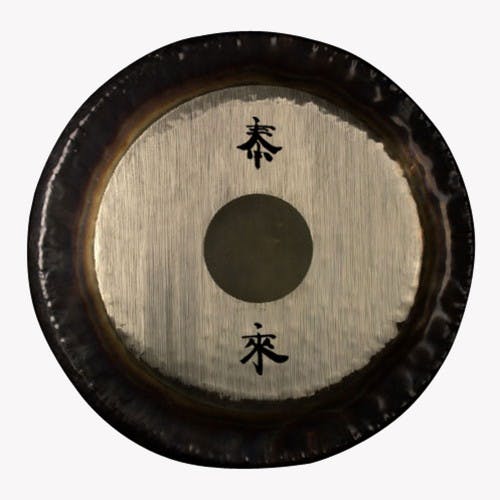
Delivery Information This is a very large item and requires special delivery to ensure it arrives safely and securely. Please contact our drum department on 01483 456 777 for full details before confirming your order.Theres percussion, theres drums ... and then theres a gong. Not every band or music project needs one but when you want resonance, great Asian infused sound and a sustain that lasts until youre off stage, packed away and half way home you need a gong.Used for everything from ceremonies to stage shows the Gong is a traditional instrument that takes the form of a flat, circular metal disc which is hit with a mallet.Symphonic GongsThe oldest version of the instrument, Symphonic Gongs have a slightly raised surface (without boss) with a harmonic and universal sound structure. The fundamental note of the gong is balanced with the instruments complex overtones. The characterizing word Symphonic thereby should not be misinterpreted as describing the literal sense of classical symphonic orchestra application but its original sense to unite harmonic sounds. The describing word universal shall be understood as “sound in its entirety”.Priming the GongLarge flat gongs may be primed by lightly hitting them before the main stroke, greatly enhancing the sound and causing the instrument to speak sooner, with a shorter delay for the sound to bloom. Keeping this priming stroke inaudible calls for a great deal of skill. We love these unique pieces here at Andertons. From the day they arrived instore theyve garnered great attentionHeres what Paiste have to say about this gongOur oldest version of the instrument, Paiste Symphonic Gongs have a slightly raised surface with a harmonic and universal sound structure. The fundamental note of the gong is balanced with the instruments complex overtones. A good starting point for a gong collection, the Symphonic contains even proportions of various gong characteristics, which can be brought forth using different mallets and striking points. Symphonic Gongs feature some of our largest examples of the instrument, like the 60 SGM and the extraordinary 80, the worlds largest gong.Gongs belong to the oldest and most important musical instruments of South East Asia. Their origins may be traced back to the second millennium B.C., but it is assumed that the gong is much older. In Chinese history, gongs are mentioned around 500 A.D., attributed to a nation called HSI YU between Tibet and Burma during the reign of Emperor Hsuan Wu.Historic research provides us with four main centers - Burma, China, Annam, Java - at least 7 gong shapes and sound structures stem from these regions. Only few families knew the tradition of gong making as it was passed from generation to generation. The art of making gongs was veiled in a sense of magic. Gong makers believed that a gong could only succeed with the help of higher powers, and that they were exposed to forces more so than ordinary humans.The gong was an important element in the lives of Far East people and is still in some countries today. In Asian families, the gong was an attribute of wealth and served as a status symbol. In rites, the gong was used in the evocation of ghosts and in the banning of demons. Touching a gong brought you fortune and strength. In rituals of the Far East, the gong has retained its special significance to this day.As a musical instrument, the gong accompanied celebrations, funeral ceremonies, songs, and theater plays. In the music of the Asian high cultures, the gong was used as an orchestral instrument. Orchestras with gong plays containing up to 18 notes were not seldom. They were also played in private concerts at residences.Since about 1790, gongs were used in European orchestras. Since then, the terms Tam Tam for flat gongs, and Gong for bossed gongs, have become customary. However, the authentic term in all languages of the origin countries is GONG.

Feefo Trusted Service Awards
Our independent awards recognise the top brands for customer service. Winners are decided based on the ratings they receive from their customers.